Last updated 10.14.2026
Synthetic vs. donor vs. your own bone: Types of dental bone grafts
Compare major dental bone-graft material categories, learn why different materials are used, and know what to ask when a graft is recommended.
If you’ve been told that you may need a bone graft before dental implants, one of your next questions may be surprisingly specific: What kind of bone will be used?
There isn’t just one type of dental bone-graft material. Depending on the treatment, clinicians may consider bone taken from your own body, processed human donor material, animal-derived material, synthetic material or a combination of materials.
Those categories have meaningful differences, but they should not be treated like products on a shopping list. The size and location of the bone deficiency, the purpose of the graft, your health history, the planned implant positions and the surgical approach all help determine which material may be appropriate.
That means there is rarely a useful answer to the question, “Which bone graft is best?” A better question is, “Why is this graft material being recommended for the bone problem you see in my mouth?”
Why are different bone-graft materials used?
Understanding the different types of bone grafts and how they work is important, since a doctor may state you are not a candidate for dental implants unless you have a bone graft.
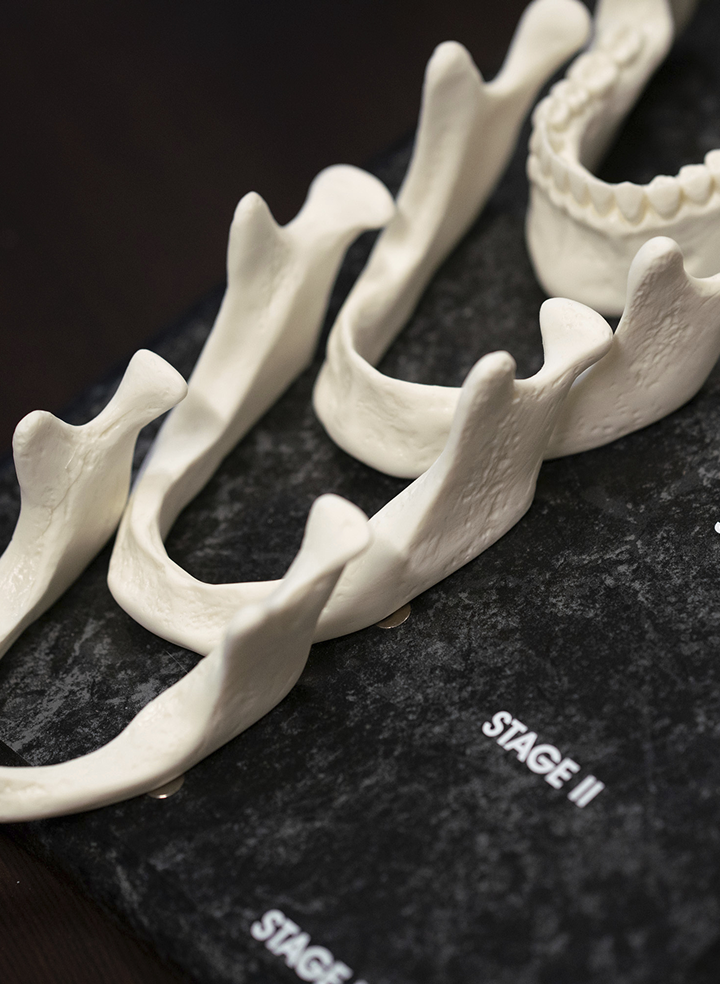
Dental implants are placed in the jawbone, so the amount and location of available bone are important parts of treatment planning. Bone may be limited after long-term tooth loss, gum disease, injury, extraction or simply because of a person’s anatomy. Bone grafting may be used for different purposes. One graft may help preserve bone in an extraction socket. Another may be intended to add width to a narrow area of the jaw. A different procedure may be used to develop bone near the sinus in the upper jaw.
Those are not interchangeable clinical problems, which helps explain why grafting does not always involve the same material or technique.
A 3D CBCT x-ray scan can help the clinical team evaluate the available bone and nearby structures. From there, the clinician can consider where implants would need to be placed, what type of restoration is planned and whether grafting would help support that treatment.
Not every dental implant patient needs a bone graft. If grafting is recommended, understanding its purpose is the first step toward understanding why a particular material has been selected.
What is a graft using your own bone?
A graft that uses your own bone is called an autogenous or autologous graft. The bone may be collected from another area within the mouth or, for larger needs, from another donor site selected by the surgeon.
One reason clinicians may consider this approach is that the graft contains the patient’s own bone cells and natural bone structure. Using your own bone also means that bone has to be collected from somewhere else on your body.
That additional harvesting step can affect the complexity of the procedure, recovery and discomfort because there may be a second surgical area to heal. The amount of bone available from a particular donor site can also be part of the planning.
If your clinician recommends using your own bone, ask where it would come from and why that source is appropriate for the graft being planned. Find out whether both areas will have separate recovery instructions and what you should expect from each.
Using your own bone should not automatically be interpreted as the “natural” choice or therefore the best choice for every situation. The reason for selecting it should be tied to your specific treatment plan.
What is donor bone used in dental grafting?
Human donor-derived graft material is generally referred to as an allograft. The material comes from a human donor and is processed by a tissue bank under applicable standards for clinical use.
Unlike an autogenous graft, an allograft does not require the clinician to harvest bone from a second area of your body. Depending on the procedure, avoiding that second surgical site can be a meaningful consideration.
Donor-derived material can provide a scaffold that supports the body’s bone-healing process. Different forms of donor material can have different characteristics, so the category name alone does not tell you everything about how a particular material will be used.
It is reasonable to have questions about human donor tissue. Some patients want to know about screening and processing. Others may have personal or religious concerns about the source.
Bring those questions up before treatment. Ask what category of material is being proposed, how it is processed, why it fits the procedure you are having and whether there are clinically reasonable alternatives. A good treatment discussion should make room for those concerns rather than assuming they do not matter.
What are animal-derived bone graft materials?
An animal-derived graft is known as a xenograft. In dentistry, these materials may be derived from an animal source such as bovine material and are processed for clinical use.
The material should not be thought of as a transplanted piece of living animal bone. Processing removes organic components using radiation and extreme temperatures according to the applicable manufacturing and regulatory requirements. The processed material is placed in position and helps maintain space so that your bone can grow into this space. Over many months the graft is resorbed and the new bone remains.
As with donor-derived material, specific products can differ. A broad term such as “bovine graft” does not tell you how the material behaves in a particular procedure or why it has been chosen.
Some patients have religious, ethical or personal preferences that affect whether they are comfortable with an animal-derived material. Tell the care team before treatment if that applies to you. The useful conversation is whether another material or treatment approach is clinically appropriate and what tradeoffs occur if an alternative graft material is used.
You should not have to wait until procedure day to learn the source category of a graft material being placed in your body.
What are synthetic dental bone grafts?
Synthetic bone-graft materials are manufactured rather than derived from a human or animal donor. They may include calcium-based ceramics or other biocompatible materials designed to provide a framework for your bone to grow into.
For patients concerned about donor sources, that distinction can make synthetic materials particularly interesting. But “synthetic” does not automatically mean safer, better or more effective.
Different synthetic materials can have different handling properties and may resorb or promote new bone at different rates. The importance of those characteristics depends on what the clinician needs the material to do in the treatment area.
If a synthetic graft is being recommended, ask for the name and category of the material and what role it is intended to play. You can also ask whether it will be used by itself or combined with another graft material.
Likewise, if you prefer a synthetic option, tell the clinician. Your preference belongs in the conversation, but the team still needs to determine whether that material is appropriate for the procedure being considered.
Is one type of dental bone graft better than the others?
There is no universally best bone-graft material for every patient and every procedure. The materials have different characteristics, and the clinical plan matters.
A clinician choosing a graft may consider the size, shape and location of the bone deficiency. The team may also think about whether the graft needs to maintain space, how the material is expected to resorb overtime, and when implant placement may occur.
Your health matters as well. Medical history, medications, healing considerations, nicotine use and oral hygiene can all be relevant. Preferences about human or animal-derived materials should also be discussed before the procedure.
In some treatment plans, clinicians may combine materials to obtain more than one desired property. That is another reason a simple “synthetic versus donor” comparison can be misleading. The recommendation may not involve choosing one category exclusively.
Rather than asking a provider to defend a material as the best, ask them to connect the choice to your scan, the graft procedure and the implant plan.
A simple way to compare the major graft categories
The categories can be easier to understand when you focus on the source of the material and the practical questions each one raises.
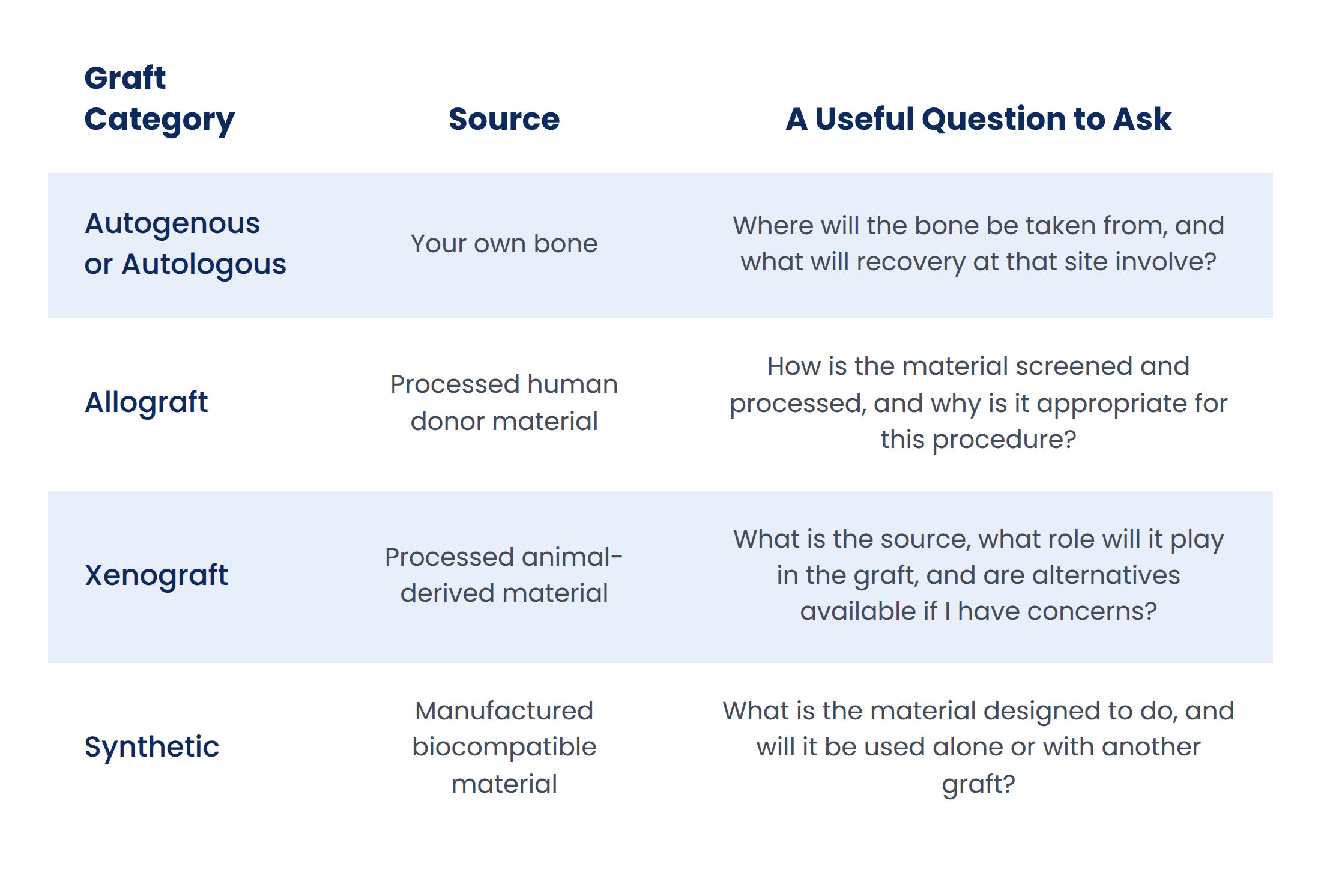
This table describes broad categories, not a ranking. Specific materials and procedures differ, and the appropriate choice still depends on the treatment being planned.
Does the graft material determine how long recovery takes?
The material is only one part of the recovery picture. The size of the graft, treatment area, surgical technique, soft-tissue closure, blood supply, whether implants were placed at the same time and individual health can all affect healing.
A small graft used around an extraction site should not automatically be expected to follow the same timeline as a larger ridge reconstruction. Two people can therefore receive graft materials from the same general category and still have very different treatment schedules.
Follow the instructions provided for medication, food, cleaning, activity, dentures or other appliances and nicotine use. Contact the treating team if pain or swelling is worsening rather than improving, bleeding is difficult to control, or fever, drainage, wound opening or another concerning symptom develops.
Before moving ahead with implant placement, the clinician may use an examination and imaging to determine whether the treatment area has developed adequate support. If healing needs more time, the planned implant date can change.
What is the graft material actually doing while you heal?
The word “graft” can create the impression that the material simply replaces a missing section of jawbone and immediately becomes finished bone. Healing is more complex than that.
Depending on the material and procedure, graft material may provide a framework, help preserve space or support the body’s bone growth process. Biological changes in the bone continue long after the surgical area begins to feel comfortable. The choice of which graft to choose depends on the clinical purpose.
This is another reason the material name cannot tell you how quickly you will be ready for an implant. Ask what the clinician expects the graft to accomplish in your particular treatment area and how they will determine when the site is ready for the next step.
Can you choose which bone-graft material is used?
You should be able to discuss the material and express your preferences, especially if you have concerns about donor or animal sources. That does not mean every graft material is interchangeable.
If you prefer not to use a particular source, tell the clinician early in the planning process. Ask which alternatives are reasonable for the bone problem being treated and whether choosing another approach would affect the procedure, healing, implant timing or cost.
Informed consent should not require you to recognize a product name or understand technical biomaterials terminology. But it should include an understandable discussion of the material being proposed, its intended role, relevant risks and benefits.
What if two dentists recommend different graft materials?
Different recommendations do not necessarily mean that one clinician is wrong.
Start by finding out whether both clinicians are trying to solve the same bone problem. Are they proposing the same implant positions? Is the grafted area the same size? Are they planning to place the implants at the same time or at a later appointment? Are they using the same type of final restoration?
A difference in graft material may reflect a difference in surgical technique, graft site, treatment timing or restorative planning. Comparing the material without comparing those other factors can create the impression that the disagreement is simpler than it really is.
Ask each clinician to explain the complete sequence: what problem they see, what procedure they recommend, what material they would use, what healing they expect and how that plan leads to the dental implant restoration.
That gives you something much more useful to compare than two product names.
What should you ask if a bone graft is recommended?
You do not need to memorize the differences among graft materials before your consultation. A few practical questions can reveal most of what you need to understand:
What problem is the bone graft intended to address?
Can you show me the area on my 3D x-ray scan?
Which graft-material category are you recommending?
Why does that material fit this procedure?
Is the material from my own body, a human donor, an animal source or a synthetic source?
Will more than one type of graft material be used?
Will material need to be taken from another area of my body?
Will a membrane or another component be used with the graft?
What should I expect during recovery?
How might grafting change my dental implant timeline?
Are there clinically reasonable alternatives?
What symptoms after the procedure should prompt me to call?
If material source is important to you for religious, ethical or personal reasons, add that to the discussion explicitly. It is much easier for the team to address a preference before the treatment plan is finalized.
Frequently asked questions
Which dental bone-graft material is best?
There is no single material that is best for every graft. The appropriate choice depends on health factors, the treatment site, graft goal, amount and location of bone needed, implant plan and clinician’s judgment.
Is donor bone used for dental implants?
Human donor-derived material, known as an allograft, may be used in dental bone grafting. The material is processed by a tissue bank under applicable standards for clinical use. Ask your treatment team about the source, processing and role of the material proposed for you.
Is animal bone used in dental grafts?
Some dental graft materials are animal-derived, commonly from a bovine source, and processed for clinical use. If you have concerns about an animal-derived material, discuss them before treatment and ask whether another clinically appropriate approach is available.
Can I request a synthetic bone graft?
You can discuss that preference with your clinician. Synthetic materials may be appropriate for some procedures but not necessarily every graft. Ask what alternatives are reasonable and what differences they would make to your treatment.
Does using my own bone mean I will have two surgical sites?
An autogenous graft requires bone to be collected from another site, which may be within the mouth or another area selected by the surgeon for a larger volume of bone. Ask where the bone would be obtained and what recovery is expected at both the graft and donor sites.
Does every dental implant require a bone graft?
No. Bone grafting is considered when the evaluation indicates that it may be needed for the proposed implant plan or to preserve bone in a treatment area. Many implant patients do not require grafting.
Next steps
If a bone graft is part of a proposed dental implant plan, you do not need to choose a material from a list before seeing the scan or understanding the procedure. Start by asking what bone problem the clinician is trying to solve. Then ask what material is being recommended, where it comes from and why its characteristics fit that particular job.
Schedule a free consultation with ClearChoice to review your 3D x-ray imaging and discuss whether bone grafting may be part of your dental implant treatment. If a graft is recommended, the team can explain the proposed material, treatment sequence and questions that apply to your individual plan.
This article provides general educational information and does not recommend a particular graft material for any individual. Material selection, surgical risks and benefits, recovery, implant timing and dental implant candidacy must be evaluated by a qualified clinician.