Last updated 03.27.2026
Alternatives to dental implants: tooth replacement options and how to choose
Not everyone chooses dental implants. Learn common tooth replacement options, when each may be considered, and what to ask at a ClearChoice Dental Implant Center consultation.

If you're exploring alternatives to dental implants, you're not alone. Many people researching tooth replacement options want to understand what choices are available and which option may best fit their needs, preferences, and budget.
Dental implants are one approach to replacing missing teeth, but they are not the only one. Options like dental bridges, partial dentures, full dentures, and snap-in dentures may also be considered depending on your situation.
The right choice often depends on factors like how many teeth are missing, where they're located, your oral health, and whether you prefer a fixed or removable solution.
Quick answer: There are several alternatives to dental implants
There are multiple ways to replace missing teeth, and each option comes with its own set of considerations.
People often look for alternatives to dental implants due to:
Cost considerations
Preference for non-surgical options
Timeline expectations
Medical or anatomical factors
The "best" alternative depends on your individual case. What works well for one person may not be the right fit for another.
First, what are dental implants?
Dental implants are a tooth replacement option that typically includes:
A small post placed in the jawbone
A restoration (such as a crown, bridge, or full set of teeth) attached to that post
Treatment often involves both a surgical phase and a restorative phase, with planning based on your anatomy and goals.
Understanding this structure can help clarify how alternatives differ— especially when comparing surgical and non-surgical approaches.
Tooth replacement options: A quick overview
If you're exploring missing tooth replacement, here are some common options:
Dental bridge (fixed, uses adjacent teeth for support)
Partial dentures (removable, for one or more missing teeth)
Full dentures (removable, for many or all teeth)
Snap-in/Implant dentures (implant-supported removable option)
Each option varies in terms of stability, maintenance, and cost structure.
Dental bridge: A common alternative to dental implants (for some people)
A dental bridge is a fixed option that replaces one or more missing teeth by anchoring to neighboring teeth.
It may be considered when:
Adjacent teeth are healthy and able to support the bridge
A fixed (non-removable) solution is preferred
The missing tooth is in a location where a bridge is appropriate
Considerations:
Relies on surrounding teeth for support
May require preparation of adjacent teeth
Cleaning and hygiene routines may differ from natural teeth
A dental bridge can be a practical solution in certain cases, but it may not be ideal for every situation.
Partial dentures: Removable tooth replacement for one or more missing teeth
Partial dentures are removable appliances designed to replace one or several missing teeth.
They may help with:
Restoring appearance
Supporting basic chewing function
Partial dentures can be made from different materials and designs, depending on the case.
Considerations:
May use clasps that attach to existing teeth
Some movement may occur during use
Require regular cleaning and maintenance
Fit may change over time
They are often considered for single tooth replacement options or when multiple teeth are missing.
Full dentures: A non-surgical alternative when many teeth are missing
Full dentures are used when most or all teeth in an arch are missing.
They may:
Replace many teeth without surgery
Restore overall appearance
Considerations:
Fit may change over time as the mouth changes
Adhesives may be used in some cases
Lower dentures may feel less stable for some people
For those looking for additional stability, some patients explore implant-supported options.
Snap-in dentures: A stability-focused option (Note: Uses implants)
Snap-in dentures are a type of removable denture that attaches to implants for added stability.
They differ from traditional dentures in that they:
Snap into place using implant anchors
May feel more secure during daily activities
Considerations:
This option still involves implants
Requires evaluation to determine candidacy
Maintenance and cleaning routines may differ
Snap-in dentures can be a middle-ground option for those comparing dentures vs implants, offering increased stability while remaining removable.
Dentures vs implants: How to compare (without assuming one is best)
When comparing dental implants vs dentures, it can be helpful to consider:
Stability (fixed vs removable)
Daily routine (removal, cleaning, maintenance)
Long-term care (repairs, relines, adjustments)
Personal goals and comfort preferences
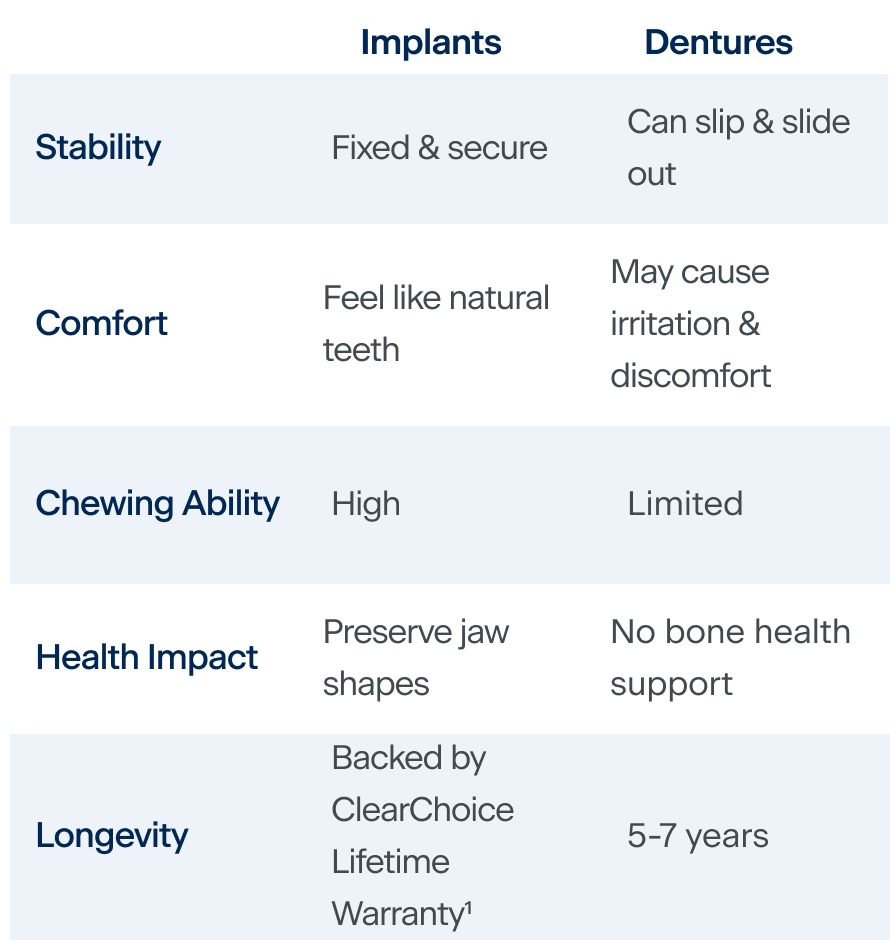
Each option may work well in different situations, and the right choice often depends on your priorities.
"Cheaper alternative to dental implants": What "cheaper" can mean
When searching for a cheaper alternative to dental implants, many people are focused on upfront cost.
However, cost can be viewed in different ways:
Initial cost vs long-term maintenance
Repairs, relines, or replacements over time
What is included in the treatment plan
When comparing options, it may help to ask:
What services are included?
What follow-up care is expected?
How often might adjustments or replacements be needed?
A lower upfront cost may not always reflect the full picture over time.
Best alternative to dental implants: A simple decision framework
Rather than looking for a single "best" option, it may help to consider:
How many teeth are missing?
Where are the missing teeth located? (front vs back)
What is the condition of surrounding teeth?
Do you prefer removable or fixed solutions?
What are your budget and timeline considerations?
Are there any health or bone-related considerations?
These factors can help guide a more personalized decision.
Alternatives by situation
Alternative to dental implant for one tooth
For a single missing tooth, options may include:
A dental bridge
A partial denture
The right approach depends on the condition of adjacent teeth and your overall goals.
Alternatives to dental implants for front teeth
When replacing a front tooth, aesthetics often play a key role.
Options may include:
Dental bridges designed to blend with surrounding teeth
Partial dentures (in some cases)
The best choice depends on alignment, appearance goals, and structural considerations.
Alternatives to dental implants for back teeth
Back teeth handle more chewing force, which may influence treatment decisions.
Options may include:
Bridges
Partial dentures
An evaluation can help determine which option may best support function and durability.
"Holistic alternatives to dental implants": What people mean and what to ask
When people search for holistic alternatives to dental implants, they may be referring to:
Non-surgical approaches
Minimally invasive options
It's important to focus on evidence-based care, function, and long-term oral health.
If this is a priority, consider asking:
What options align with my preferences?
What are the benefits and limitations of each approach?
A consultation can help clarify what is appropriate for your specific situation.
Bone loss questions: "Alternative to bone graft for dental implants"
In some cases, bone structure may be a factor in treatment planning.
Options and recommendations can vary depending on:
Anatomy
Overall oral health
Treatment goals
Imaging and evaluation are typically needed to determine what approaches may be considered.
What to expect at ClearChoice Dental Implant Center
At ClearChoice Dental Implant Center, the process is designed to help patients understand their options and plan treatment with clarity.
A typical consultation may include:
Discussion of your goals and medical history
Imaging and evaluation
Review of potential treatment options (including non-implant alternatives where appropriate)
Coordinated planning and long-term maintenance guidance
For those exploring payment options, third-party financing options may be available for qualified applicants.
FAQs: Alternatives to dental implants
What's the best alternative to dental implants?
The best alternative depends on your specific needs, including how many teeth are missing, where they are located, and your preferences for treatment.
What is a cheaper alternative to dental implants?
Options like dentures or bridges may have lower upfront costs, but long-term maintenance and replacement needs can vary.
Are bridges better than implants?
It depends on the individual case, including the condition of surrounding teeth and overall treatment goals.
Are dentures a good alternative to implants?
Dentures may be a suitable option for some patients, particularly when looking for a non-surgical approach.
Can I replace a front tooth without an implant?
Yes, options such as bridges or partial dentures may be considered depending on your situation.
How long can dental implants last?
Dental implants are designed to be a long-term solution and can last a lifetime with proper care, though restorations may require maintenance over time.