Last updated 10.21.2026
Tooth replacement options in Atlanta: What to know before you choose

Written by: Dr. Samira Salari, DMD
Compare tooth replacement options in Atlanta, from bridges and dentures to dental implants, and learn what to expect at a free ClearChoice® consultation.
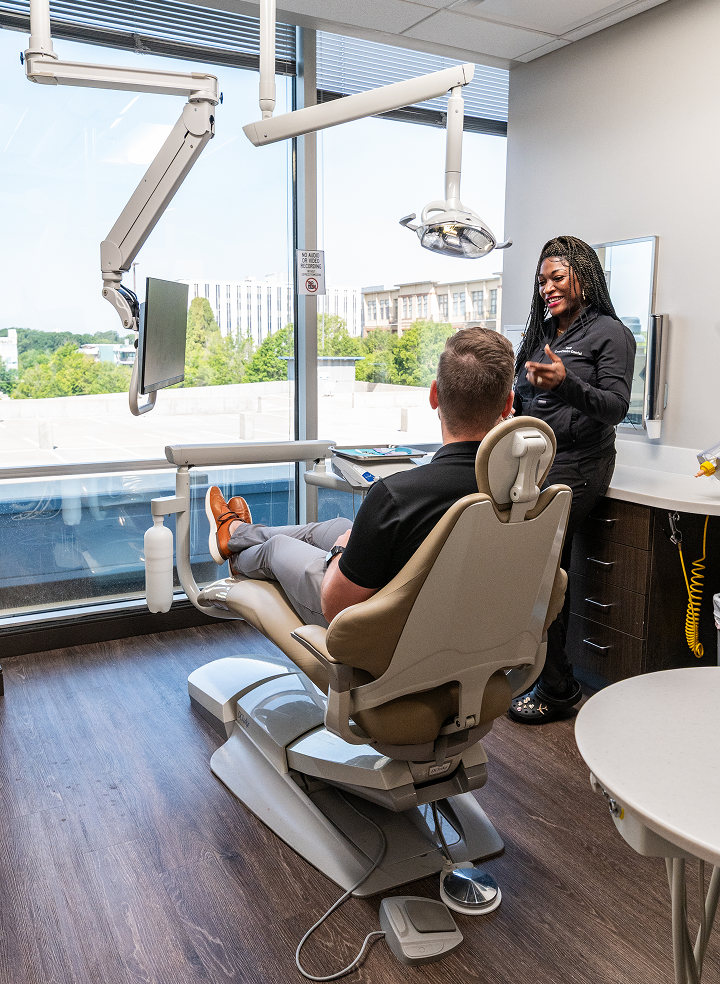
Maybe it is a denture that slips when you laugh. Maybe it is a bridge that has started to fail, or a gap you have been working around for years. Whatever brought you here, one question usually comes first: What are my options for replacing missing teeth?
If you live in the Atlanta area, you have plenty of choices when it comes to providers and treatment types. That is good news, but it can also make the decision feel overwhelming. Bridges, partial dentures, full dentures, snap-in dentures and fixed implant-supported teeth all work differently, and no single option is right for everyone.
ClearChoice has dental implant centers in Atlanta, Decatur, Alpharetta and Newnan, so you can choose the location that is most convenient for consultations and follow-up visits.
This guide walks through the most common tooth replacement options, how to compare them based on everyday life and what to expect when you meet with an implant team. The goal is to help you arrive at your first conversation informed and ready to ask good questions.
What are the main tooth replacement options?
Tooth replacement generally falls into two categories: Removable options that you take out for cleaning and fixed options that stay in place during daily use. Within those categories, the right fit depends on how many teeth are missing, where they are located, the health of your gums and jawbone and what you want your teeth to do for you.
Here is a quick look at the choices you are most likely to hear about. For a broader overview, see our guide to permanent teeth replacement or our comparison of alternatives to dental implants.
Dental bridges
A dental bridge replaces one or more missing teeth by anchoring a replacement tooth to the natural teeth on either side of the gap. It is a fixed option, which means you do not remove it. Bridges depend on healthy neighboring teeth for support, and they do not replace the tooth root in the jawbone.
Partial dentures
A partial denture is a removable appliance that fills the spaces left by missing teeth and typically attaches to your remaining natural teeth. Some people prefer partial dentures because they offer a removable, non-surgical approach. Others find that they feel less stable than a fixed option. If you are weighing the two, our guide to partial dentures vs dental implants covers the tradeoffs.
Traditional full dentures
When most or all teeth in an arch are missing, a traditional full denture is one of the most familiar solutions. Full dentures rest on the gums and are removed for cleaning. Many people wear them successfully, though some notice movement over time, particularly with lower dentures, as the jaw changes. Our page on dentures vs implants offers a side-by-side look.
Single tooth and multiple tooth implants
A dental implant replaces the root of a missing tooth with a small post placed in the jawbone, topped with a custom crown. Because an implant stands on its own, it does not rely on neighboring teeth for support the way a bridge does. Implants can also support a bridge when several teeth in a row are missing. Learn more about single tooth implants or how to replace a missing molar.
Snap-in dentures
Snap-in dentures, also called implant dentures or implant-supported dentures, are removable dentures that attach to dental implants. The implants add stability, which can mean less shifting while you eat and speak, but you still take the denture out for cleaning. Read more in our guide to snap-in dentures or explore implant dentures.
Fixed full arch implants
Fixed full arch restorations, often called full mouth dental implants, replace an entire arch of teeth with a set of teeth secured to multiple implants. They stay in place during normal daily use and are cleaned much like natural teeth, though they still need regular home care and professional maintenance. Wondering how they compare with a removable option? Our article on snap-in dentures vs permanent full arch implants breaks down the differences, and you can learn more about full mouth dental implants on our services page.
How to compare your options based on everyday life
It is tempting to ask which option is “best.” A more useful question is which option fits your life. Consider how each choice might affect:
Eating: Which foods do you want to enjoy without second-guessing?
Stability: Are you comfortable with a removable option, or do you want teeth that stay put?
Cleaning: What routine is realistic for you, including any limits on dexterity or mobility?
Treatment path: Are you comfortable with surgery and healing time, or do you prefer a non-surgical approach?
Budget: What is the full cost over time, not only the upfront price?
Appearance: How important is it that your teeth look and feel natural?
There is no wrong set of priorities. One person may value stability above everything else. Another may prefer a removable solution that is easier to clean or lighter on the budget. A good consultation connects those priorities to what is clinically possible for you.
Why jawbone health matters for tooth replacement
The jawbone can change after teeth are lost because natural tooth roots are no longer present. How much bone remains, where it is located and its quality can all affect implant planning, particularly when teeth have been missing for many years.
That does not mean bone loss rules out implants. It means your bone needs to be evaluated. A 3D CBCT scan gives your dental team a detailed view of the jaw and surrounding anatomy so they can determine whether implants can be placed as planned or whether preparatory treatment or a different approach makes more sense. Our guide to dental implants with bone loss explains how teams approach these situations.
If you were told years ago that you did not have enough bone for implants, it may be worth a second look. Techniques and treatment options evolve, and a previous opinion does not necessarily describe what is possible today.
Keep in mind that bone is only one part of the picture. Gum health, medical history, medications, tobacco use and healing considerations also shape your treatment plan.
Is age a factor in choosing tooth replacement?
Age alone is rarely the deciding factor. There is generally no strict upper age limit for dental implants. Dental teams pay closer attention to overall health, bone, gum condition and healing ability than to the number on a birth certificate. An older adult with well-managed health conditions may be a stronger candidate than a younger person with untreated oral disease.
That is why a consultation includes a medical and dental history. Bring an up-to-date list of medications, along with information about major health conditions, recent procedures and any specialists you see. Our guides on dental implants for seniors and whether you are too old for dental implants go into more detail.
If a spouse, adult child or friend is helping you through the process, that support can be valuable for transportation, questions and keeping track of details. Many adults also manage treatment on their own. The right level of support is up to you.
What should you expect at an Atlanta dental implant consultation?
A useful consultation turns a broad question like “Can I get dental implants?” into a specific conversation about your mouth. At a ClearChoice Dental Implant Center, your visit may include:
A review of your dental and medical history
An exam of your gums, remaining teeth and existing dental work
3D x-ray imaging to show the available bone and important anatomy
A conversation about your goals, concerns and priorities
A review of the options that may fit, along with a personalized treatment plan and estimate
If you wear dentures, bring them with you. Seeing what has and has not worked well helps your provider understand what to improve.
This is also the time to share what is motivating you. Maybe a denture moves when you eat, or you have started skipping certain foods. Maybe you are facing the loss of your remaining teeth and want to understand the difference between fixed and removable replacements. Those details make the conversation about your daily life, not just an x-ray.
By the end of your visit, you should understand which options are recommended, why they are recommended and what the major tradeoffs are. Learn more about what happens during a dental implant consultation, or read our guide to dental implants near you in Atlanta for tips on comparing providers and planning your next step.
Questions worth asking before you choose a treatment
You do not need a long list of technical questions to have a productive consultation. Start with these:
What does my 3D x-ray scan show about my bone?
Which tooth replacement options are appropriate for me, and why?
Would my new teeth be fixed or removable?
Would I need any treatment before implant placement?
If I receive temporary teeth first, when would I get my final teeth?
How will I clean and maintain my new teeth?
How many appointments and follow-up visits should I expect?
What is included in the total treatment estimate?
What could change the treatment plan or cost?
Consider reviewing the list with a trusted family member or friend before your appointment. A second set of ears can make it easier to remember details afterward, as long as that is something you want.
How to compare tooth replacement costs
The price of tooth replacement depends on what is actually being treated. A traditional denture, an implant-supported denture and a fixed full arch restoration are different treatment scopes, so comparing only a headline price can be misleading.
When you review an estimate, ask whether it includes:
Imaging and diagnostics
Extractions, if needed
Any expected preparatory care, such as bone grafting
Implant placement and anesthesia or sedation
Temporary and final teeth
Follow-up visits
If you are comparing providers, make sure each estimate covers the same arch or arches and a similar scope of treatment. ClearChoice provides a personalized, all-inclusive estimate after your evaluation so you can see what your plan covers.
Financing is worth evaluating separately from price. A monthly payment can make treatment easier to manage, but it does not show the total you will pay. Review the interest rate, fees, repayment term and total repayment before deciding whether an option fits your budget. Third-party financing options may be available for qualified applicants, and ClearChoice does not process insurance directly, though you may be able to submit your bill to your insurer for potential reimbursement depending on your plan. Visit our page on dental implant costs and financing to learn more.
Cost matters, but it works best as one factor you weigh after you understand what treatment is clinically appropriate and what is included.
Long-term care belongs in the decision
Whichever option you choose, ongoing care is part of the treatment. Ask how to clean your teeth at home, what professional maintenance is recommended and who handles adjustments or repairs later. A removable denture is cleaned differently than a fixed full arch restoration, and your own dexterity or mobility may make one routine more practical than another.
Think beyond procedure day. A good tooth replacement plan should make sense when your new teeth are delivered and also months and years later.
Frequently asked questions
What is the best tooth replacement option?
There is no single best option. The right choice depends on how many teeth are missing, your oral health, your jawbone, your lifestyle and your budget. A consultation with imaging helps match those factors to the options that make sense for you.
Are dental implants always better than dentures?
Not always. Traditional dentures, implant-supported dentures and fixed implant restorations involve different tradeoffs in stability, removability, cleaning, treatment requirements and cost. The better choice is the one that fits your clinical needs and priorities.
Can I get dental implants if I have no natural teeth?
Possibly. People with complete tooth loss may be evaluated for implant-supported dentures or fixed full arch treatment. Available bone, oral health, medical history and other clinical factors help determine which options may be appropriate.
What if I have been missing teeth for years?
Long-term tooth loss can lead to changes in the jawbone, so 3D imaging is important when implants are being considered. Bone loss may affect treatment planning, but it does not on its own tell you whether implants are possible.
Where can I find a ClearChoice center in the Atlanta area?
ClearChoice has dental implant centers in Atlanta, Decatur, Alpharetta and Newnan. The Atlanta center is located in the Buckhead area on Piedmont Road. You can also compare all Atlanta-area centers and schedule a free consultation at the one that works best for you.
Ready to explore your tooth replacement options in Atlanta?
Choosing how to replace missing teeth is a personal decision, and it starts with a small set of facts: What your mouth looks like today, what your 3D imaging shows, what your health history means for treatment and what you want your new teeth to do for you.
Schedule a free consultation at a ClearChoice Dental Implant Center in Atlanta, Decatur, Alpharetta or Newnan to review your findings, compare your tooth replacement options and receive a personalized treatment plan and estimate. You can also explore our full range of dental implant services before you visit.
This article is intended for general educational purposes and does not replace personalized medical or dental advice. Treatment options, candidacy, recovery and results vary by patient. A qualified provider must evaluate each patient.