Last updated 10.01.2026
Tooth decay vs. cavity: The difference explained
Learn why gum recession happens, what it means for keeping your teeth, and which gum recession treatment options can help protect your smile.

Tooth decay is the process. A cavity is the result. Decay describes the ongoing damage that plaque and acid cause to a tooth's surface, while a cavity is the physical hole left behind once that damage breaks through the enamel. Understanding the difference between tooth decay and a cavity matters, because catching decay early can mean the difference between a simple filling and a more involved procedure. This article breaks down how decay becomes a cavity, how dentists treat each stage and what you can do to stop the process before it starts.
Is tooth decay and a cavity the same thing?
No, but they're closely related terms describing two stages of the same problem. Tooth decay is the early, ongoing breakdown of enamel caused by acid-producing bacteria, while a cavity is the visible, permanent hole that decay creates once it erodes all the way through that enamel. Every cavity starts as decay, but not every instance of decay becomes a cavity, especially if it's caught and treated early.
What is tooth decay?
Tooth decay is the gradual breakdown of a tooth's hard outer layers, caused by acid-producing bacteria that live in plaque. Every time you eat or drink something with sugar or starch, the bacteria in plaque convert it into acid, which pulls minerals out of the enamel in a process called demineralization. Early decay usually does not cause pain. It often shows up as a white or discolored spot, or as new sensitivity to sweets or temperature. At this stage, decay is a process rather than a fixed structural problem, and early enamel demineralization may be managed through measures such as improved oral hygiene, fluoride, remineralization products, and dietary changes, as determined by a dental professional. Left alone, plaque hardens into tartar and the acid attack continues until it eventually breaks through the enamel. Learn more about how plaque differs from tartar and why removing it matters.
What is a cavity?
A cavity is the physical hole that forms once tooth decay has eaten completely through the enamel and reached the softer dentin underneath. Unlike early decay, a cavity is a structural defect. It will not heal or reverse on its own, no matter how good your oral hygiene becomes. Cavities often bring symptoms that decay alone does not: a visible pit or dark spot, food catching in the tooth, sharp pain when biting down or lingering sensitivity to hot, cold or sweet foods. Once decay reaches the dentin, it tends to spread faster, since dentin is softer and less mineralized than enamel. Left untreated, it can reach the tooth's inner pulp, where the nerve and blood supply live, leading to a persistent jaw or toothache, and infection. At this stage, treatment is not optional, and a dentist needs to remove the damaged material and rebuild the tooth's structure.
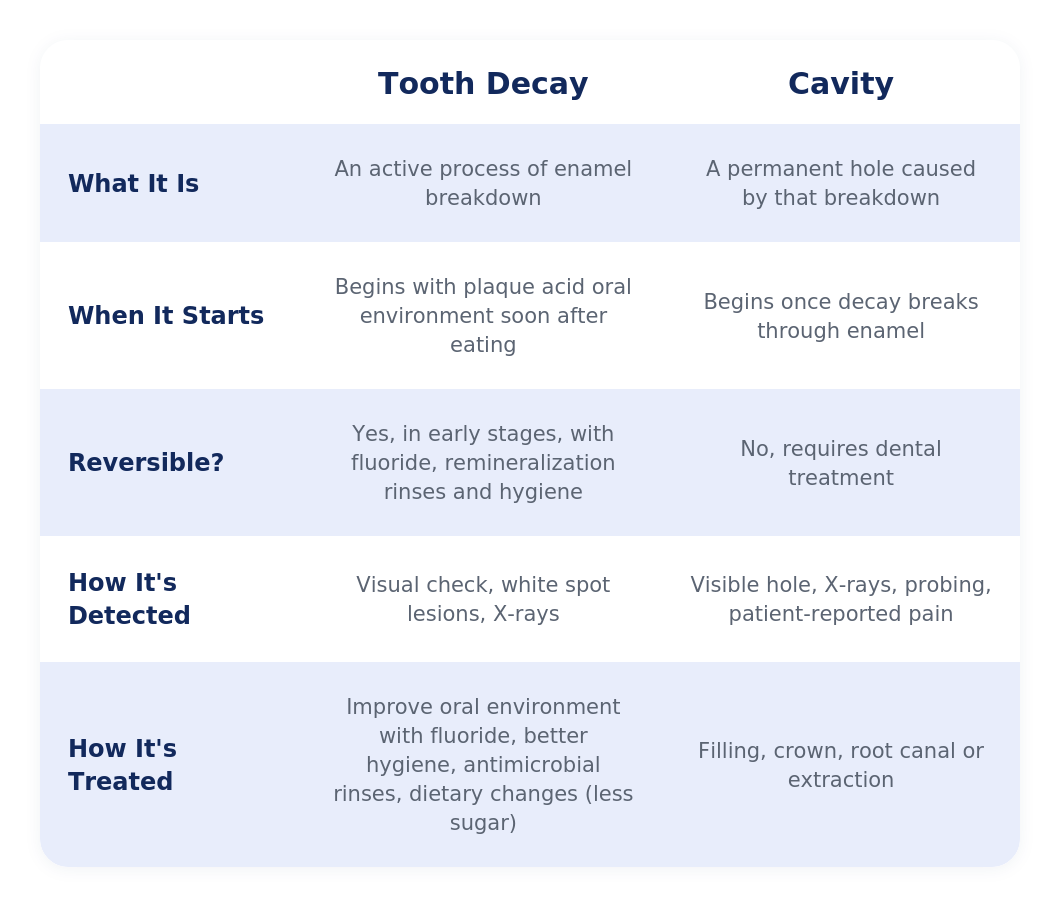
Tooth decay vs. cavity: Key differences at a glance
Here is how the two stages compare side by side:
How tooth decay becomes a cavity
Decay does not turn into a cavity overnight. It moves through a fairly predictable sequence:
1. Plaque builds up. A sticky film of bacteria forms on the tooth surface, often within hours of eating.
2. Acid production begins. Bacteria in plaque convert sugars and starches into acid, which starts pulling minerals out of the enamel.
3. Early decay develops. The enamel loses minerals faster than saliva can replace them, sometimes appearing as a chalky white spot. The tooth's structure is still intact at this point.
4. Enamel weakens further. Continued acid exposure erodes the enamel until it can no longer hold its structure.
5. A cavity forms. Decay finally breaks all the way through the enamel into the dentin, creating a permanent hole. This is the exact point where decay becomes a cavity.
6. Decay advances toward the pulp. Without treatment, the damage continues through the dentin toward the tooth's nerve, raising the risk of infection, a root canal or, in advanced cases, loss of the tooth.
How dentists treat decay vs. a cavity
Treatment gets more involved the further decay has progressed, so dentists typically start with the least invasive option that will still solve the problem:
Fluoride treatment and remineralization solutions. For early decay or white spot lesions, professional fluoride and remineralization products may support enamel remineralization when clinically appropriate.
Dental sealants. A thin protective coating applied to the chewing surfaces of back teeth, which may help reduce the risk of further decay in appropriate patients.
Fillings. Once a cavity has formed, the dentist removes the decayed material and fills the space with composite resin or another material.
Crowns. When a cavity is so large that there is more filling than tooth, a crown is a cap that covers and reinforces the remaining tooth structure.
Root canal. If decay has reached the pulp, the infected tissue is removed and the tooth is cleaned and sealed.
Extraction. If a tooth is too damaged to save, extraction may be the only remaining option.
Can tooth decay be reversed?
Yes, but only in its earliest stage. While the enamel is still intact and no hole has formed, early enamel demineralization may be managed through fluoride treatment, improved brushing and flossing, and dietary changes, depending on individual circumstances. This window closes once decay breaks through the enamel and becomes a cavity. From that point on, the damage is permanent and needs to be repaired rather than reversed. The same logic applies to gum disease, where early gingivitis can often be reversed, but more advanced damage cannot.
How to prevent tooth decay and cavities
A few consistent habits go a long way toward keeping decay from ever starting:
Brush twice a day with fluoride toothpaste
Floss daily to clear plaque from between teeth (A water flosser is often recommended)
Use antibacterial rinses
Limit sugary and starchy snacks and drinks
Drink fluoridated water when it's available
Visit a dentist for regular cleanings and checkups
Tooth decay vs. cavity: The bottom line
The difference between tooth decay and a cavity comes down to timing and reversibility. Decay is the early, ongoing process, while a cavity is the permanent hole that decay leaves behind once it breaks through the enamel. Catching decay before it becomes a cavity may allow for a broader range of treatment options, including more conservative approaches. If you're unsure where you stand, a dental professional can help evaluate your individual situation.
Tooth decay and cavity FAQs
Does tooth decay always turn into a cavity?
No. If decay is caught while it's still limited to the enamel, it can sometimes be stopped or reversed with fluoride treatment and better oral hygiene. Decay only becomes a cavity once it breaks all the way through the enamel into the dentin.
Can you have a cavity without pain?
Yes. Many cavities, especially small or early ones, cause no pain at all. Pain tends to show up once decay reaches the dentin or nerve, which is why regular checkups and X-rays catch far more cavities than symptoms alone.
How can I tell if I have a cavity or just sensitive teeth?
Sensitivity alone does not confirm a cavity. Sensitivity can come from worn enamel, gum recession or a cavity. A dentist can tell the difference with a visual exam and X-rays, so it's worth getting checked rather than guessing.
Is a cavity the same as a hole in your tooth?
Yes. A cavity is the clinical term for a hole caused by tooth decay. It is a permanent structural change that will not close or heal on its own and needs to be treated by a dentist.