Last updated 08.13.2026
Plaque vs. tartar: Key differences & how to remove each

Written by: Dr. Lisa Hoang, DMD, MS
Learn the key differences, how plaque hardens into tartar, and how to remove and prevent each to protect your teeth and gums.
Here's the short answer: plaque is a soft, sticky film you can remove yourself with regular brushing and flossing. Tartar is hardened plaque that has bonded to your teeth — and once that happens, only a dental professional can remove it. Plaque and tarter can also build up on teeth that are attached to dental implants.
The two terms get used interchangeably, but the distinction matters. How you treat a fuzzy film on your teeth is very different from how you treat a hard, discolored buildup near your gumline. Get the two confused, and you might try to fix a problem that home care simply can't solve — or worse, try to scrape away something that shouldn't be touched without professional tools.
This guide walks through what separates plaque vs. tartar, how one turns into the other, how to remove and prevent each, and when it's time to bring in a professional.
Plaque vs. Tartar on Teeth: A Quick Comparison
Before getting into the details, here's a side-by-side look at how plaque and tartar differ:
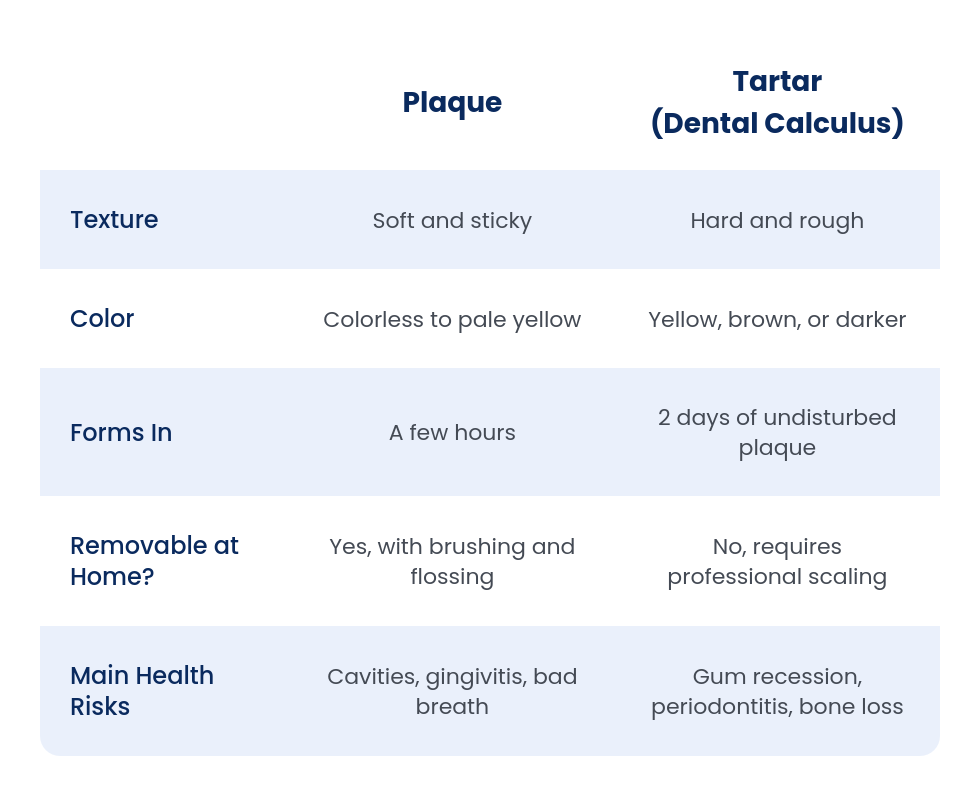
Keep this table in mind as a quick reference. Notice that almost every row comes back to the same theme: plaque is early-stage and manageable, while tartar is later-stage and out of your hands. That's really the heart of the plaque vs. tartar comparison, timing determines what you can and can't fix yourself. The sections below go deeper into why each of these differences exists, and what to do about them.
What Is Dental Plaque?
Plaque is a soft bacterial biofilm that forms on your teeth continuously, whether you notice it or not. It develops when bacteria in your mouth feed on sugars and starches from food, producing acids that irritate gum tissue and erode enamel over time. This process happens on every tooth surface, including along and just beneath the gumline, which is exactly where problems tend to start.
A few things worth knowing about plaque:
It's usually colorless or pale yellow, which is why it's easy to miss in the mirror.
It can form within just a few hours of brushing, since bacteria are constantly active in the mouth.
It's soft enough to remove with consistent daily brushing and flossing, this is the window where you have control.
Left alone, though, that window closes fast.
What Is Tartar (Dental Calculus)?
Tartar — also known as dental calculus is what plaque becomes once it's allowed to sit on the tooth surface long enough to absorb minerals from saliva. Those minerals cause the plaque to calcify and bond directly to the tooth, and sometimes below the gumline as well. Tartar that forms above the gumline is usually easy to spot; tartar that forms below it is often harder to see and only identified during a professional exam.
Unlike plaque, tartar is:
Visible, typically appearing yellow, brown, or almost black over time.
Most common along the gumline, where plaque tends to accumulate.
Rough-textured, which makes it easier for new plaque to cling to it, accelerating buildup.
Impossible to remove with brushing alone, tartar bonds too firmly to the tooth for a toothbrush or floss to budge it.
That last point is worth sitting with, because it's the main takeaway of the whole plaque vs. tartar conversation: one is within your control day to day, and the other isn't.
How Does Plaque Turn Into Tartar?
Plaque doesn't sit still. If it isn't cleared away, it can begin hardening into tartar in as little as two days, as minerals in saliva calcify the bacterial film and fuse it to the enamel. From that point forward, it's no longer something a toothbrush can undo.
This is why dentists emphasize consistency over occasional effort. Brushing thoroughly occasionally, or catching up on flossing every few days, still leaves gaps where plaque has time to harden. It's the daily habit, not the occasional deep clean, that interrupts this cycle before tartar has a chance to form.
Once tartar sets in, the clock resets in an unhelpful way: its rough surface gives new plaque more places to grip, so buildup can accelerate rather than simply repeat. This calcification step is really the turning point in the plaque vs tartar story, everything before it is preventable at home, and everything after it isn't.
How to Remove Plaque at Home
The encouraging news is that plaque is the part of this equation you can manage yourself, every day, with the right routine. A few habits make the biggest difference:
Brush thoroughly, twice a day. Use a soft-bristled brush and fluoride toothpaste, angled toward the gumline where plaque tends to collect. Two minutes with a consistent pattern as you move the toothbrush around your mouth, both morning and night, is the standard most dentists recommend.
Clean between your teeth daily. Flossing or using an interdental brush removes plaque from the areas a toothbrush can't reach, often where tartar first develops.
Add an antibacterial mouth rinse. A rinse can reduce the bacteria that form plaque in the first place, especially in hard-to-reach spots.
If you're not sure which products can help make a difference, our guides to the best toothpaste and toothbrush for gum disease and best products for gum disease break down what to look for.
How to Remove Tartar
Here's the part that surprises a lot of people: tartar cannot be removed at home, period. Once plaque has hardened and bonded to the tooth, no amount of brushing will lift it back off.
It can be tempting to try scraping visible tartar off yourself, but this isn't a safe shortcut. Using metal tools or picks on your own teeth can scratch enamel and injure gum tissue, sometimes creating more places for plaque and tartar to build up going forward.
Removing tartar safely requires a dental hygienist, who uses a process called scaling to lift calcified deposits from the tooth surface. If tartar has developed below the gumline, your hygienist may also recommend root planing, which smooths the tooth root to help gum tissue reattach and heal.
This is also the reasoning behind the general recommendation to schedule a professional cleaning roughly every six months, or more often if your dentist advises it based on how quickly tartar tends to build up for you.
What Happens if Plaque and Tartar Aren't Removed?
Plaque and tartar carry different risks if they're left in place.
Untreated plaque can lead to:
Cavities, as the acids it produces wear away enamel
Gingivitis, the early stage of gum disease, marked by red or bleeding gums around your natural teeth and any implant teeth
Persistent bad breath
Untreated tartar tends to escalate things further. Because its rough surface attracts more plaque, buildup can accelerate, and over time, this can progress to periodontitis, a more advanced form of gum disease that involves gum recession, bone loss around a tooth or implant, and eventually loose or lost teeth. Dentists take this progression seriously not just for cosmetic reasons, but because the bone and tissue that support your teeth generally don't rebuild themselves once they're gone.
There's an important distinction here worth remembering: gingivitis is often reversible with improved brushing, flossing, and professional cleanings. Advanced gum disease is not something home care alone can undo, it requires professional treatment. If you're not sure what healthy gum tissue looks like for comparison, our guide on what healthy gums look like is a useful reference point, as is our broader overview of periodontal disease.
How to Prevent Plaque and Tartar Buildup
Prevention is almost always easier than treatment, and it doesn't require anything complicated — just consistency. A solid daily routine includes:
Brushing twice a day with a fluoride toothpaste
Cleaning between your teeth daily, with floss or an interdental brush
Using an antibacterial rinse to help reduce bacteria between brushings
Limiting sugary and starchy foods, which fuel the bacteria that produce plaque
Staying hydrated, since saliva helps naturally clear food particles and bacteria
Keeping up with regular professional cleanings, since this is the only way to remove tartar once it's formed
None of these habits are especially demanding on their own. What matters is doing them consistently because, as covered above, plaque only has two days before it starts hardening into something a toothbrush can no longer touch.
When to See a Dentist
Good home care goes a long way, but some signs call for professional attention rather than more brushing. Reach out to a dentist if you notice:
Visible tartar along the gumline that hasn't gone away
Gums that bleed regularly, not just occasionally
Swelling, tenderness, or gums that appear to be receding
Teeth that feel loose or shifted
Any symptoms that don't improve despite diligent daily care
These can be signs of periodontitis, which requires professional treatment to manage and can't be reversed through brushing and flossing alone. Acting early gives you a much better chance of protecting both your teeth and the bone that supports them; the longer advanced gum disease goes unaddressed, the more difficult it becomes to treat. Our page on periodontal disease treatment walks through what that process typically involves.
Protect Your Smile With ClearChoice
Healthy gums do more than keep your mouth comfortable, they're the foundation that supports your natural teeth, and, for patients who've already experienced tooth loss, healthy gums around your implants are essential to the long-term success of implant tooth replacement. Consistent oral hygiene and regular cleanings are part of protecting that foundation for years to come.
If gum disease has progressed to the point of affecting the bone around your teeth, you're not out of options. ClearChoice can help you understand what's happened, what it means for your oral health going forward, and what solutions might help you get back to a full, confident smile. And if tooth replacement with dental implants is part of that path, keeping up with oral hygiene and maintenance for dental implants is just as important for protecting your new smile long-term.
Ready to talk to someone about your options? If you have loose or failing teeth, or your dentist has told you that you might have irreversible periodontitis, Schedule a free ClearChoice consultation to discuss the overall health of your mouth and teeth and what comes next.
Plaque vs. Tartar: The Bottom Line
Plaque and tartar aren't the same problem, and they don't call for the same solution. Plaque is soft, forms daily, and comes off with consistent brushing and flossing. Tartar is hardened plaque that only a dental professional can safely remove.
The most reliable way to manage both is the combination dentists have recommended for decades: a genuinely consistent daily oral hygiene routine, paired with regular professional cleanings that catch what a toothbrush can't. For more guidance on keeping your smile healthy long-term, explore our dental implants FAQ or reach out to schedule a consultation.