Last updated 10.30.2026
Missing teeth in San Diego: Why tooth loss still matters as you get older

Written by: Dr. Stephen Alfano, DDS, MS
Learn why missing teeth can affect eating, oral health and quality of life as you age and what San Diego adults should know about tooth replacement options.
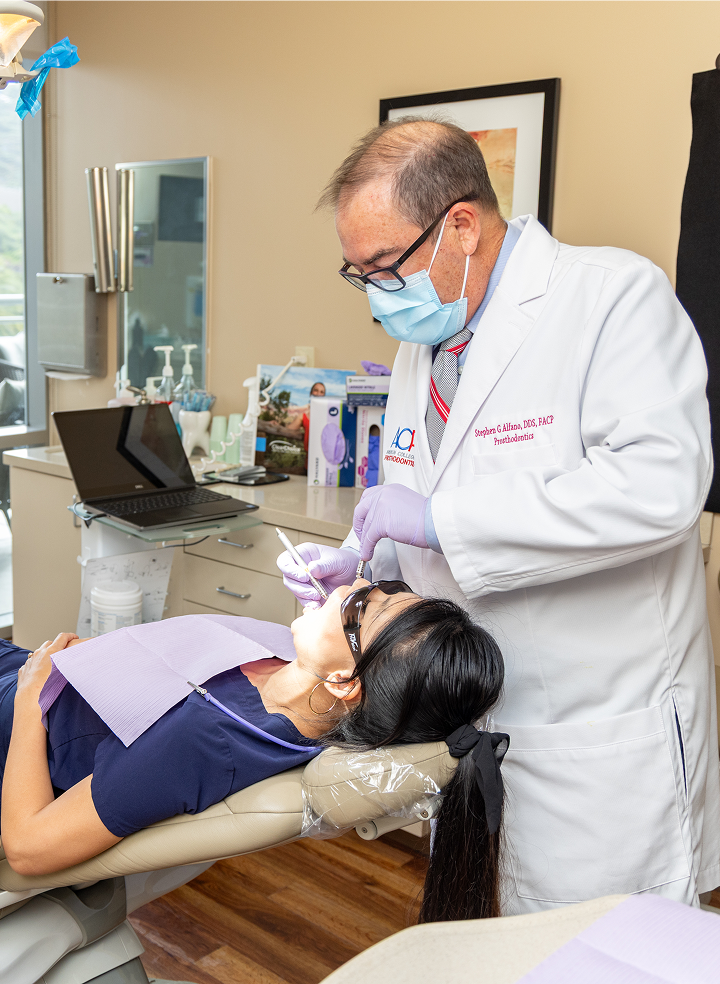
Losing teeth is not an inevitable part of getting older. Many adults keep most or all of their natural teeth throughout their lives, particularly when they have access to preventive care and receive treatment when dental problems develop. Still, tooth loss remains a reality for many older adults, and its effects can extend well beyond the appearance of a smile.
A missing tooth can change how you chew. Several missing teeth may lead you to avoid certain foods or rely more heavily on one side of your mouth. When most or all teeth are gone, eating comfortably can become much more difficult. For some people, the changes happen gradually enough that they begin to feel normal.
That is one reason population statistics tell only part of the story. Even in a community where complete tooth loss is relatively uncommon, the experience of an individual with failing or missing teeth can be significant. For San Diego adults exploring tooth replacement, the more useful question is not how their city compares with another city. It is what is happening in their own mouth and what options are appropriate for addressing it.
Tooth loss can develop gradually
People do not always recognize how much they have adapted to dental problems. One back tooth is lost, so chewing shifts to the other side. Another tooth becomes painful, so certain foods disappear from the grocery list. A removable denture begins to move, and additional adhesive becomes part of the morning routine.
Over time, these adjustments can make a significant dental problem feel ordinary. Someone may say they can still eat “most things” without realizing how many foods they have stopped choosing. Others may avoid restaurants or social meals because they are concerned about a loose denture or uncomfortable teeth.
The Centers for Disease Control and Prevention notes that severe tooth loss can affect nutrition, speech and quality of life. Tooth loss is also associated with dental disease that develops over time, particularly tooth decay and periodontal disease. These broader patterns are useful for understanding why preserving natural teeth and replacing teeth that cannot be saved both deserve attention.
An evaluation can help separate problems you have learned to live with from problems that may still be treatable. It can also establish whether replacement is needed for one tooth, several teeth or an entire jaw of teeth.
Start by asking which teeth can be preserved
Dental implants are designed to replace missing or severely failing teeth. They are not a reason to remove natural teeth that can predictably be maintained.
That distinction is particularly important for patients researching full-mouth implant treatment. Advertising can make the process appear straightforward: failing teeth come out and a new set of teeth goes in. In practice, the first question should be whether the existing teeth truly need to be removed.
A dental examination can identify decay, tooth fractures, periodontal disease and problems with previous dental work. Some teeth may have a reasonable treatment option while others have a poor long-term prognosis. The answer can differ from tooth to tooth.
If extraction is recommended, ask why. Find out whether the recommendation is based on extensive structural damage, advanced periodontal disease or another condition that limits the likelihood of maintaining the tooth. If you are uncertain about removing teeth that are not causing obvious problems, ask the clinician to show you the findings and explain the alternatives.
Preserving a natural tooth when appropriate and replacing a tooth that cannot be maintained are both legitimate treatment goals. The important point is that the diagnosis should lead the decision.
What happens to the jaw after teeth are lost?
Natural teeth interact with the surrounding jawbone. After a tooth is removed, the bone in that area begins to remodel with a change in size and shape. Research on extraction sockets has documented changes in both the width and height of the alveolar ridge after tooth loss, with substantial remodeling occurring during the first months after extraction.
For someone considering dental implants, these changes matter because implants are placed in the jawbone. The care team needs to determine whether there is adequate bone in the appropriate location for the proposed implant and restoration.
The amount of bone change varies from person to person and from one area of the mouth to another. Someone who lost a tooth years ago should not assume that implants are impossible, just as someone who recently lost a tooth should not assume that no additional planning will be needed.
Three-dimensional X-ray imaging can provide a more detailed view of the jaw and surrounding structures than a visual examination alone. ClearChoice® uses this 3D imaging as part of implant treatment planning. The care team can use those findings to evaluate potential implant locations and discuss whether additional procedures, such as bone grafting, may be appropriate.
If you were previously told that you do not have enough bone for implants, bring that history to the consultation. Dental implant techniques and individual treatment plans vary, so current X-ray imaging is more useful than assuming an earlier opinion still answers the question.
Tooth replacement depends on how many teeth are missing
Replacing one missing tooth is a different treatment problem from replacing most or all teeth in an arch. Understanding that difference can make the range of implant terminology much easier to navigate.
For a single missing tooth, an implant and crown may be considered. A conventional bridge may also be an option in some situations. When several teeth are missing, treatment might involve individual implants, an implant-supported bridge or a removable prosthesis depending on the location of the missing teeth and the condition of the rest of the mouth.
Patients who have lost most or all teeth in an upper or lower arch may have a different set of choices. A conventional complete denture rests on the gums and is removable. An implant-supported removable denture uses implants to improve support or retention but still comes out for cleaning. A fixed full arch restoration is supported entirely by implants and remains in place during normal daily use 24/7.
These options should not be treated as interchangeable versions of the same product. They involve different treatment requirements, maintenance routines and costs. Some patients value having teeth that remain fixed in place, while others are comfortable with a removable restoration and don’t mind taking it out for cleaning.
The right discussion begins with what needs to be replaced and what the patient wants to improve about their current situation.
If you already wear dentures, identify the problem you want to solve
Many adults function successfully with conventional dentures. Wearing a denture does not mean you need dental implants.
For others, however, a removable denture may become increasingly difficult to manage. A lower denture may move during meals or conversation. Food can collect underneath it, and repeated sore spots may make eating uncomfortable. Changes in the supporting tissues over time can also affect how a denture fits, and may eventually require reline or remake.
If those problems sound familiar, explain them specifically during the consultation. Saying “I don’t like my dentures” provides less useful information than explaining that the lower denture moves when you chew or that you have stopped eating certain foods because it feels unstable.
Implants may be used to support different types of replacement teeth, including removable and fixed options. The care team can explain which approaches are possible based on your oral health and anatomy. An implant-supported solution may improve stability for an appropriate patient, but the expected benefits and limitations should be discussed in relation to the specific restoration being proposed.
Consider maintenance before choosing a restoration
How replacement teeth are cleaned may not seem like a major concern when you are focused on surgery, appearance or cost. It becomes much more important once treatment is complete.
Fixed implant-supported teeth do not come out for routine cleaning. Patients need to clean around the implants and beneath the restoration using methods recommended by their care team. Removable implant-supported dentures can be taken out, but the implants and attachment components still require regular care.
Implants are not immune to disease. The American Academy of Periodontology describes peri-implant diseases as inflammatory conditions affecting the tissues surrounding dental implants. Maintaining good oral hygiene and attending professional maintenance visits are important parts of long-term implant care.
Before choosing a restoration, ask the team to explain the daily cleaning routine. Find out what tools are recommended and how often professional maintenance is expected. If limited hand strength or another health condition makes oral hygiene difficult, bring that up before treatment rather than trying to solve the problem afterward.
A replacement that looks appealing on procedure day also needs to be practical in the future.
Compare cost in the context of the treatment
Dental implant costs vary because treatment plans vary. A single implant and crown cannot be compared directly with a complete fixed arch, and a removable implant-supported denture is not the same treatment as fixed full arch teeth.
When reviewing an estimate, confirm what is included. For full arch treatment, ask whether extractions are included if they are needed and whether the price covers provisional teeth during healing. Find out whether the final restoration is part of the quoted amount and what material is planned for those teeth.
San Diego County is geographically large, so the practical demands of follow-up can also matter. Ask how many visits are expected, where those appointments occur and where you would go if the restoration needs an adjustment. Treatment does not end when the implants are placed.
Understanding the complete process makes the financial comparison much more meaningful.
Frequently asked questions
Is tooth loss a normal part of aging?
No. The risk of dental disease can change over a lifetime, but losing teeth is not an unavoidable consequence of getting older. Preventive care and treatment of dental disease can help many people retain their natural teeth.
Can I get dental implants if my teeth have been missing for years?
The length of time a tooth has been missing does not determine implant candidacy by itself. The care team needs to evaluate your current bone, oral health and surrounding anatomy.
Does bone loss mean I will need a bone graft?
Not necessarily. Bone loss is a finding, while grafting is a treatment decision. Whether grafting is recommended depends on the location and amount of available bone and the implant treatment being considered.
Can I move from dentures to fixed implant-supported teeth?
Some denture wearers may be candidates for fixed implant-supported treatment, but eligibility depends on individual clinical findings. An evaluation and imaging are needed to determine which options are appropriate.
Taking the next step
Local statistics can help describe oral health across a community, but they cannot tell you what to do about your own teeth. If eating has become difficult, a denture no longer feels stable or several teeth are failing, an evaluation can help clarify what can still be preserved and what may need replacement.
During a free consultation with a San Diego-area ClearChoice team, you can review your oral health and 3D X-ray imaging, discuss appropriate tooth replacement options and learn what the proposed treatment would involve. If implants are being considered, ask about the type of restoration, long-term maintenance and any additional procedures that may be needed.
The goal is not to choose implants simply because teeth are missing. It is to understand the problem first, then decide which treatment approach makes sense for your circumstances.
Disclaimer: This article provides general educational information and does not constitute individualized medical or dental advice. Dental implant candidacy and treatment recommendations depend on individual clinical findings.